Last updated November 21, 2026
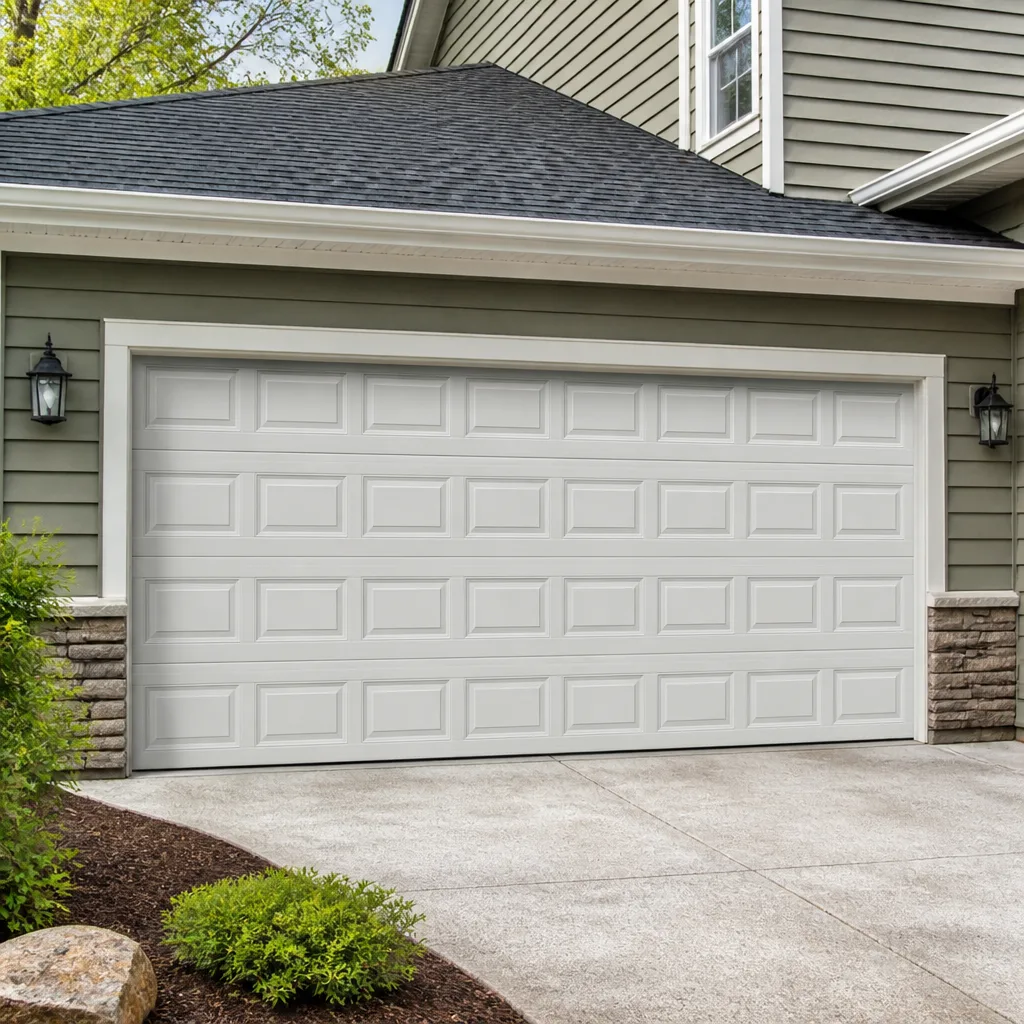 Raised-panel steel
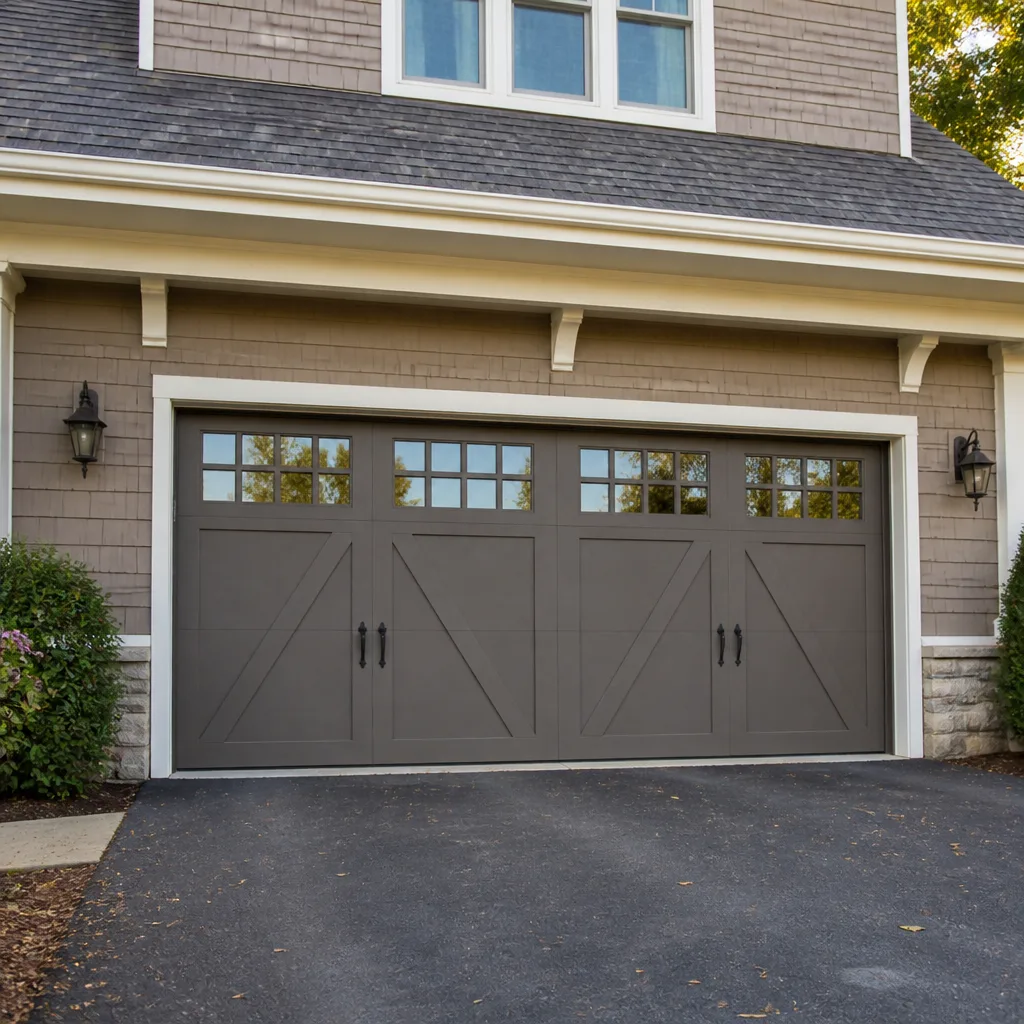 Carriage house
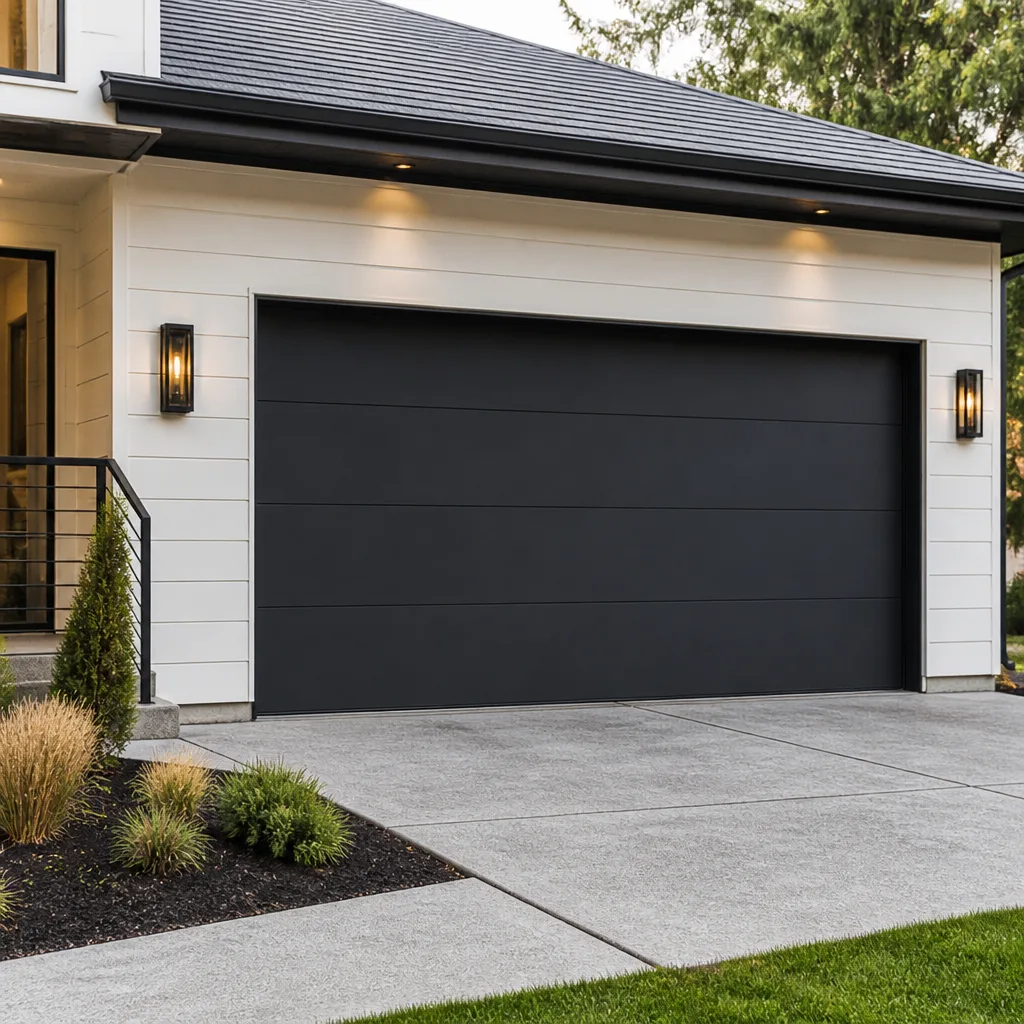 Modern flush
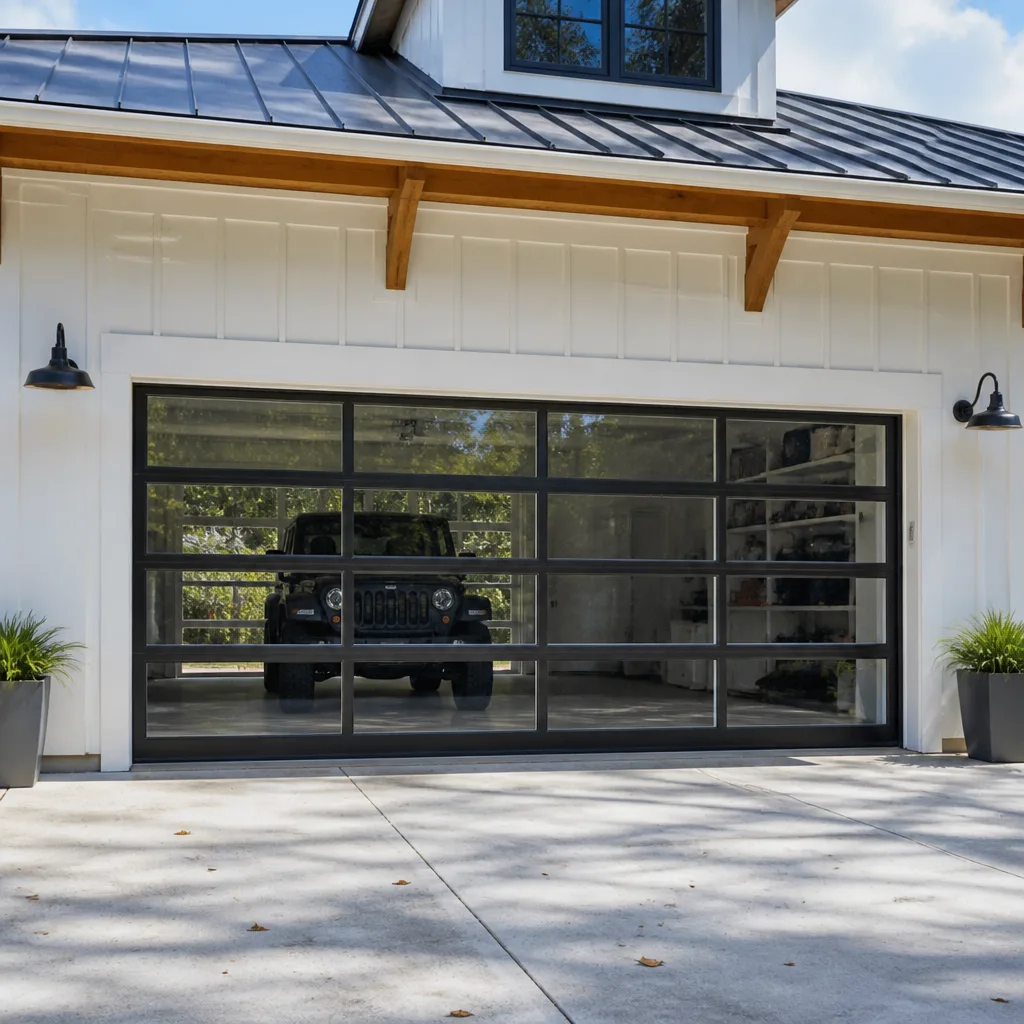 Full-view glass
 LiftMaster openers
 Chamberlain openers
Full 25-point door and opener safety check with every visit - springs, cables, rollers, tracks, and your LiftMaster or Chamberlain opener included
You get a price before we start. It does not change when the pro arrives.
Get your free estimateHow much does a garage door repair or replacement cost in Cape Coral?
A spring repair in Cape Coral usually runs $180 to $340 for one spring, and a matched pair is replaced together at roughly twice that. A new door installed here typically lands between $1,100 and $3,800 depending on size, material and wind rating, and an opener replacement runs $350 to $850. Every number below is an estimate; the written quote you get after we look at your door is the price you pay.
The Complete Guide to Garage Doors in Cape Coral
Most garage door guides are written for places where rust takes a decade to show up. In Cape Coral, humidity and salt in the air can chew through the wrong spring or cable in under two years, long before the door looks old. That single fact changes almost everything about how a garage door should be specified, installed and maintained here. This guide covers the whole system – the door, the opener, the springs, tracks, cables and sensors – and explains which parts fail together, which brands show up in which Cape Coral subdivisions, and what the local climate does to each component. By the end you’ll know what your door actually needs and when to stop troubleshooting and call someone.
Styles & brands we work with
- Raised-panel steel
- Carriage house
- Modern flush
- Full-view glass
- LiftMaster openers
- Chamberlain openers
Quick Answer
A garage door in Cape Coral needs three things a national guide won’t tell you: hardware rated for humid, salt-exposed air, a wind-load rated door that meets Lee County permit requirements, and a bottom seal suited to a slab-on-grade floor. Get those right and the door lasts. Skip them and springs, cables and brackets corrode fast, seals fail at the first storm, and the door becomes a repair you repeat every couple of years instead of a system you maintain.
Table of Contents
- How a garage door system actually works
- Why Cape Coral humidity is hard on springs, cables and brackets
- Slab-on-grade floors and why your bottom seal matters
- Hurricane-rated doors in Lee County: what the label really means
- What brand your Cape Coral home likely has, by build era
- Openers: legacy systems vs. smart-home connected models
- Spring failure is a safety issue, not just an inconvenience
- A maintenance routine that fits Cape Coral
How a garage door system actually works
A garage door is one machine made of several parts that all depend on each other. The door panels carry the weight. The torsion spring or springs above the door counterbalance that weight so a person or an opener can lift it. Cables connect the spring to the bottom corners. Tracks and rollers guide the panels. The opener supplies the push, and the safety sensors stop it from closing on something in the way. When one part fails, the others take the strain, which is why a single worn roller can eventually cost you a cable.
Here’s how the parts interact in plain terms:
- Springs hold the door’s weight. If they weaken, the opener works harder and burns out sooner.
- Cables transfer spring tension to the door. A frayed cable is a snap waiting to happen.
- Tracks and rollers keep the door moving straight. A bent track forces the opener to fight the door.
- Bottom brackets anchor the cable at the base of the door and take the most moisture exposure of any part.
- Sensors tell the opener the path is clear. Misaligned sensors make a working door refuse to close.
- The opener only lifts a balanced door. If the door is heavy, the opener is a symptom, not the cause.
We work on your brand, and that matters more than people expect. A Genie and a LiftMaster opener fail in different ways, and an Amarr door from one era has different spring geometry than a Wayne Dalton from another. Diagnosing by brand-specific behavior beats guessing. For a full breakdown of repair options, see our garage door repair service page.
Why Cape Coral humidity is hard on springs, cables and brackets
Southwest Florida’s humidity speeds up corrosion, and it hits the parts that matter most. A torsion spring, a cable, and a bottom bracket sit in the same humid air day after day. The wrong hardware – plain steel where a coated or galvanized part belongs – can show real surface rust well inside two years, and a spring that has lost material is a spring that is closer to breaking. This is the single biggest difference between garage door life in Cape Coral and garage door life in a dry climate.
The parts that fail first, in our experience in this climate:
- Torsion springs. The wire takes moisture along its length and rusts from the outside in. A rusted coil holds less tension and snaps with less warning.
- Cables. Cables fray where they bend around drums and pulleys. Add humidity and a frayed strand turns into a broken cable fast.
- Bottom brackets. These sit lowest and closest to a wet slab, so they’re the first metal to go.
- Hinges and rollers. Small steel parts seize or flatten when they aren’t lubricated and the air stays damp.
What actually holds up: galvanized or coated springs, stainless or coated cables, and heavy-duty brackets. The grade of the hardware does more for lifespan here than the brand name on the door. When we source parts, we source for this climate, not for a catalog photo. The right part, the right fix, done the same visit where possible. If you’ve already spotted rust on the coils, that’s a reason to have the door looked at rather than wait. You can read more about springs on our main Garage Door Repair Cape Coral Pros page.
Slab-on-grade floors and why your bottom seal matters
Most Cape Coral homes sit on slab-on-grade foundations, which means the garage floor is poured concrete right at ground level. There’s no raised curb, no step, no basement below. That flat relationship between door and floor changes how the bottom seal works. On a raised foundation the door can lap over a lip. On a slab, the bottom seal is the only barrier between the outside and your garage, and it has to sit true against the concrete across the full width of the opening.
What that means in practice:
- The floor decides the seal. Poured concrete is rarely dead flat. A rigid seal on a wavy slab leaves gaps. A flexible bulb-style seal conforms and closes them.
- Water control is the whole job. On a slab, storm rain that pools at the threshold needs somewhere to go. A threshold seal or a properly sized bottom seal keeps water from running under the door.
- Uneven pads are common. Newer pours and older slabs both settle. A seal that worked one year can gap the next if the concrete has shifted.
- Wind-driven rain is the test. A seal that looks fine on a calm day is the wrong test. Cape Coral storms push water sideways, and the bottom seal has to hold.
If you feel daylight under the door or find damp concrete just inside the threshold, the seal is the place to start. It’s a small part with an outsized effect on a slab home. When a seal gap is the issue, our team can sort out the sizing and the install in one visit, and if the opener or tracks are involved too, we handle garage door opener repair as well so it’s still one call.
Hurricane-rated doors in Lee County: what the label really means
Hurricane-rated and wind-load rated are not the same thing, and a lot of homeowners find that out at permit time. A wind-load rating on a product label tells you the door is tested to withstand a certain pressure. What Lee County requires for a permit is a door that meets the wind-load standard for your specific location and opening, with the documentation to prove it. A door can carry a rating and still not be the right door for your garage without the right paperwork and installation.
The steps to getting this right:
- Know your opening’s requirement. Wind-load requirements vary by location and by the size of the opening. Your city’s building department can tell you what applies to your address.
- Match the door’s rating to that requirement. The product’s wind-load rating needs to meet or exceed the number for your opening.
- Keep the documentation. Permits want the test reports and product approval for the specific door, not a generic brochure.
- Install to spec. A rated door installed with the wrong anchors or the wrong reinforcement doesn’t perform at its rating. Installation matters as much as the door.
- Confirm the permit before work starts. Most of Lee County requires a permit for a new or replaced garage door, so ask your building department up front.
This is where an installation done by someone who reads the label carefully saves real headaches. We install wind-load rated and hurricane-rated doors with the documentation your permit needs. New doors are measured, ordered and scheduled – that work takes planning, not a same-day visit – and you’ll get a free measure and a written price before anything is ordered. See our garage door installation page for how that process runs. We won’t quote you a code section or a specific rule number here, because the only authority on your address is your local building department.
What brand your Cape Coral home likely has, by build era
Cape Coral grew in waves, and the garage doors in each wave came from a different set of makers. Knowing roughly when your home was built tells you a lot about what’s hanging over the driveway before you even look. This is general pattern, not a rule – builders mixed it up, and plenty of doors have been replaced since – but it’s a useful starting point for a diagnosis.
- Earlier subdivisions. Simpler steel doors and legacy openers. Craftsman units are common in the older stock, and parts for older Craftsman models can be harder to source than you’d expect. That’s a reason to have a technician with parts on hand rather than a trip to a big-box store mid-job.
- Mid-era builds. Steel raised-panel doors from Clopay and Wayne Dalton show up a lot, often paired with a LiftMaster or Genie opener. These are the years where the hardware grade starts to matter in our climate.
- Recent construction. Builders tend to reach for Amarr doors and LiftMaster or Chamberlain openers, and increasingly smart-connected models with app control. A Raynor door turns up on some of the larger homes.
Why the brand matters: a Wayne Dalton torsion system and an Amarr door don’t wear the same way, and a LiftMaster opener has different failure points than a Genie. When a technician knows the brand, the diagnosis is faster and the right part goes on the first time. We work across eight name-brand door and opener systems – LiftMaster, Chamberlain, Genie, Clopay, Amarr, Wayne Dalton, Craftsman and Raynor – so whatever your Cape Coral home came with, it’s familiar ground.
Openers: legacy systems vs. smart-home connected models
An opener is not just a motor. It’s a small control system that talks to wall buttons, remotes, safety sensors and, on newer models, your phone. Cape Coral has both ends of that spectrum sitting on the same street: legacy openers in older homes and smart-connected units in new construction. Each fails in its own way, and the fix is different for each.
What we see with modern connected systems:
- LiftMaster and Chamberlain with MyQ. App and connectivity problems are common, and they’re usually solved by re-pairing or a firmware step rather than a new opener.
- Genie Aladdin. Connectivity and sensor faults come up, and they’re diagnosed differently than a mechanical failure.
- Craftsman legacy units. Older circuit boards and remotes are the usual suspects, and parts sourcing is the real challenge.
What we see with the mechanical side, on any brand:
- The door won’t close but the opener runs. Usually a safety sensor that’s misaligned or blocked, not the motor.
- The opener strains or stops halfway. Often a spring or balance issue making the door too heavy, not an opener fault.
- The opener hums and won’t move. Could be the drive gear, the capacitor or the logic board. Brand-specific behavior tells you which.
- Random operation. Frequently a remote or logic board problem, sometimes interference.
Because we repair the whole system, we fix the cause rather than the symptom. If your springs are weak and your opener is struggling, replacing the opener alone just buys a new motor for a door that will wear it out. One call covers the whole system – opener electronics, door panels and mechanical springs – so you’re not calling three contractors for one door.
Spring failure is a safety issue, not just an inconvenience
A garage door torsion spring stores enough energy to seriously injure someone, and the cables and brackets that hold that energy are under constant tension. This is the part of the system to treat with real caution. A trained technician with the right winding bars can do the job safely; a homeowner without the correct tools and training should not. Springs are not a do-it-yourself task, and we don’t recommend treating them as one.
What to watch for, as an inspection rather than a repair instruction:
- A visible gap in the spring coil, or the two halves hanging apart. That’s a broken spring, and the door should not be used until it’s fixed.
- Heavy rust or loss of metal on the coils, which in Cape Coral humidity is a real warning sign.
- A loud bang from the garage, which is often the sound of a spring letting go.
- A door that feels extremely heavy when lifted by hand, or won’t stay up.
- Frayed or kinked cables, or a bottom bracket that’s pulling away from the door.
If you see any of these, stop using the door and call. Spring repair is a dedicated service for us, not an afterthought, and it’s one many general handymen decline for good reason. When a spring fails, the door’s weight comes down on the opener and cables, so fixing it promptly protects the rest of the system too.
A maintenance routine that fits Cape Coral
A little upkeep goes further here than in a dry climate because moisture does the damage. You don’t need to touch the springs or cables – leave those to a technician – but a few simple checks keep the door working and catch problems before they turn into repairs.
- Lubricate the moving metal. Rollers, hinges and tracks benefit from a proper garage door lubricant a couple of times a year. This slows the corrosion our humidity drives.
- Look at the springs and cables. A visual check for rust, gaps or fraying is enough. Don’t touch them, just note what you see and call if something looks off.
- Test the safety sensors. Put an object in the door’s path and confirm it reverses. This is a quick check that catches sensor faults before they strand you.
- Check the bottom seal. Look for daylight or damp concrete under the door. A gap in a slab home lets water and pests in.
- Listen to the door. Grinding, squealing or a door that jerks on the way up is telling you something is out of balance or worn.
- Have the balance checked. A technician can confirm the springs are holding the door’s weight properly, which is the check that protects your opener.
Following this routine in Cape Coral keeps the whole system – door, opener, springs, tracks, cables and sensors – in working order, and it makes the difference between a door you maintain and a door you keep repairing.
See the difference
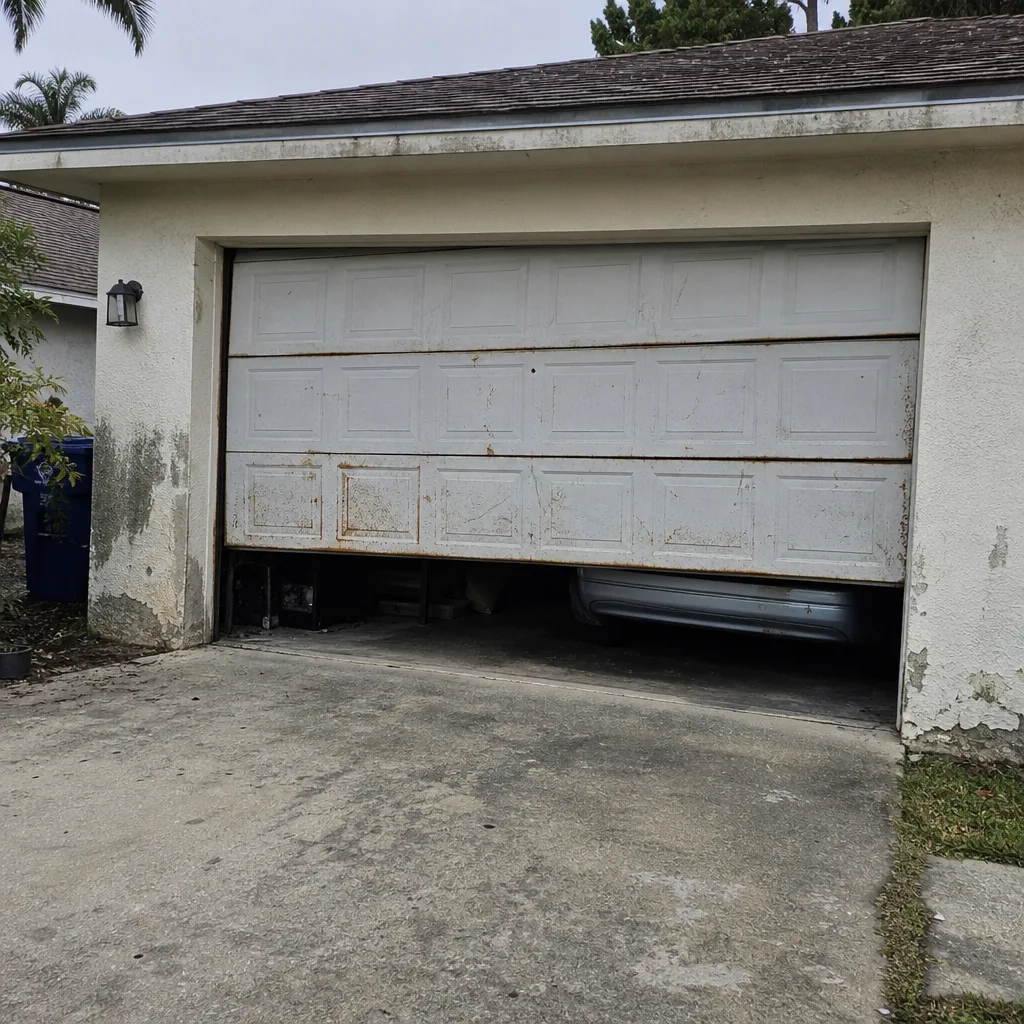 Before
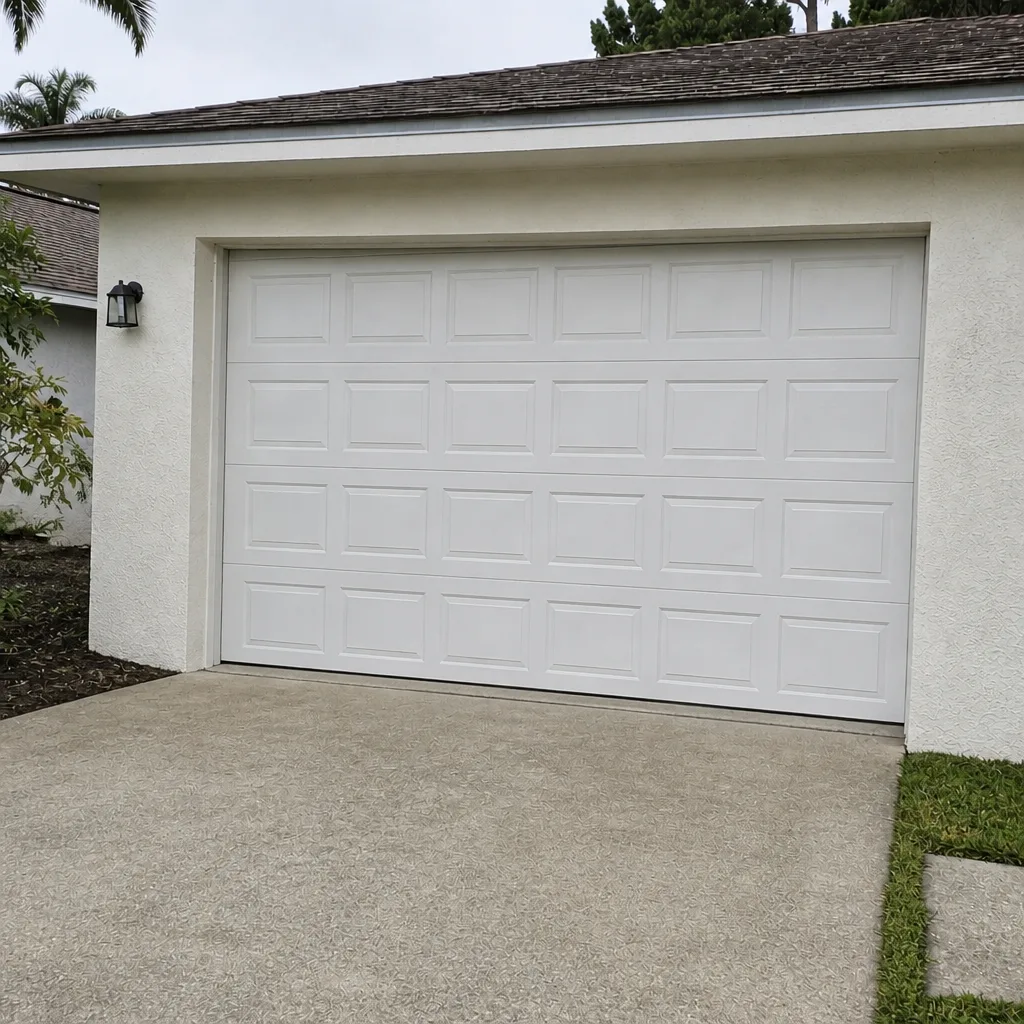 After
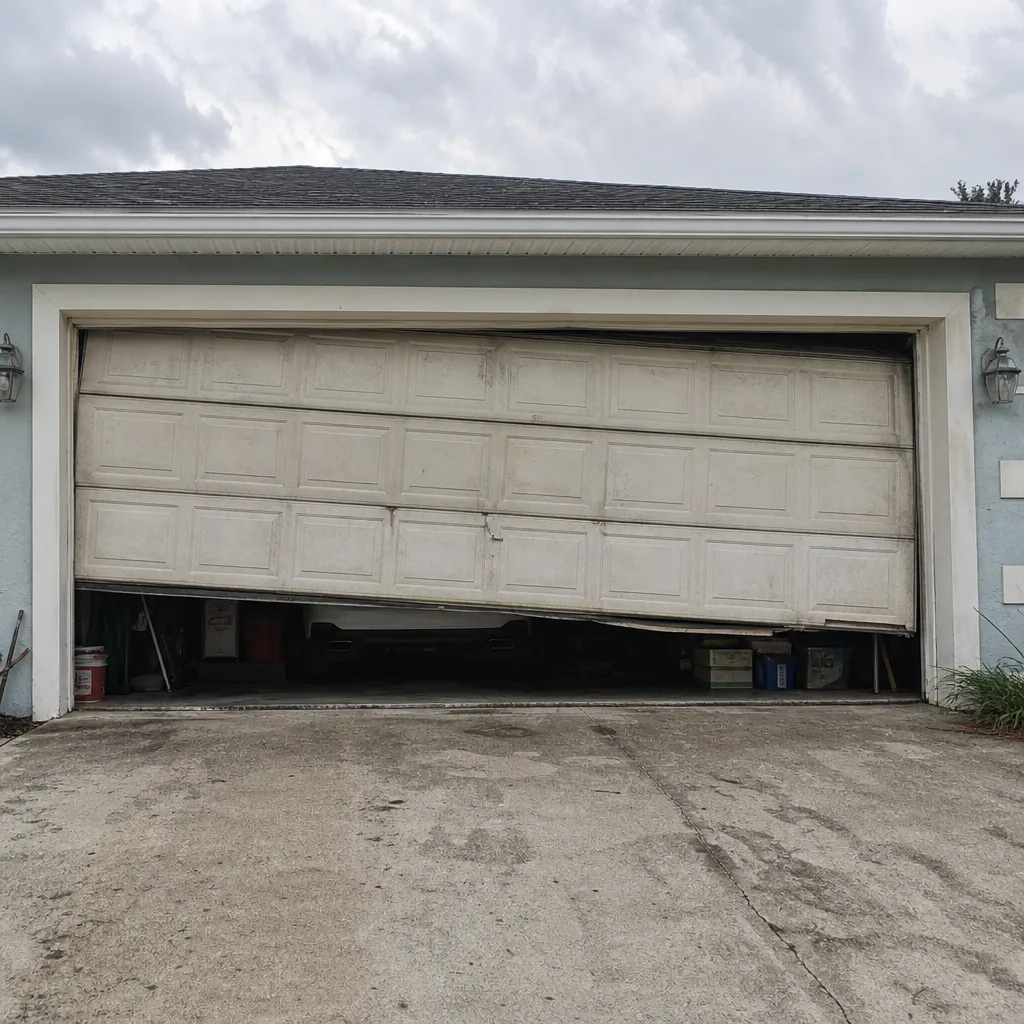 Before
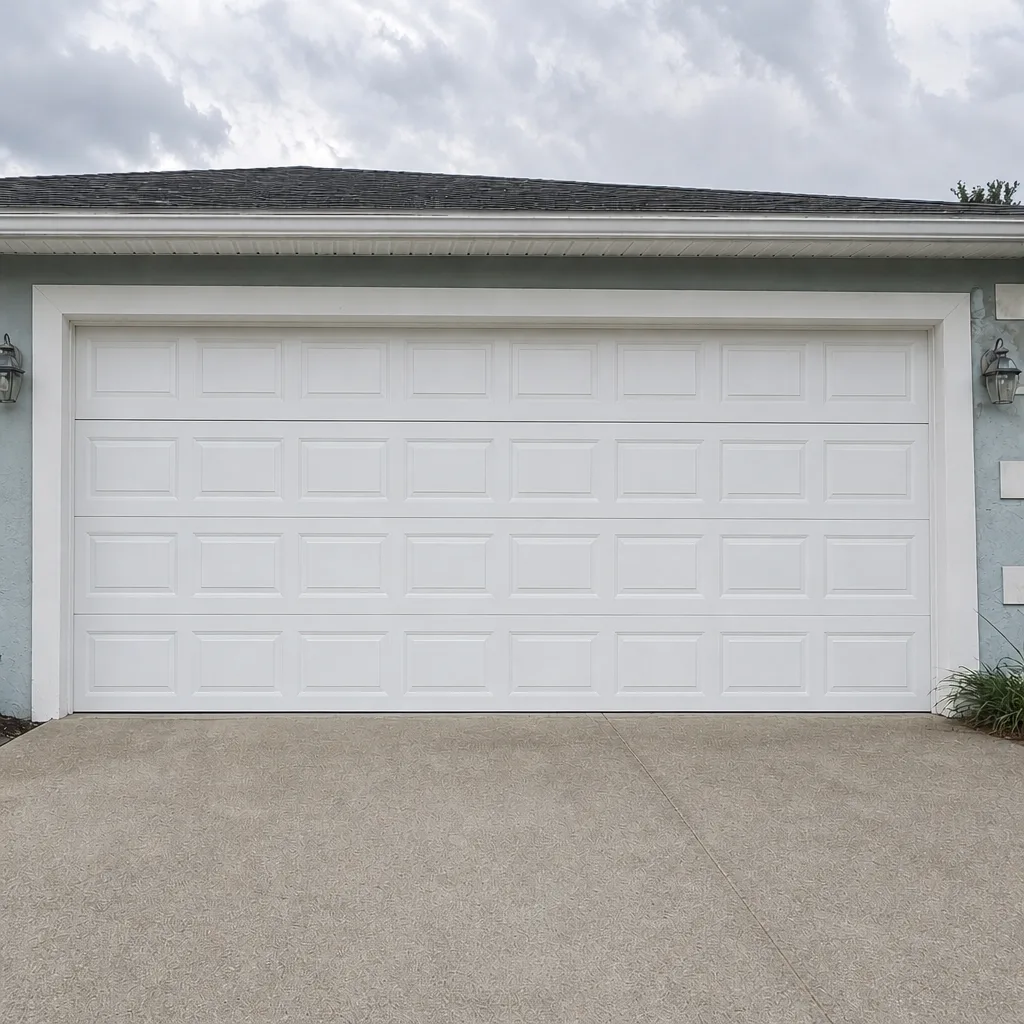 After
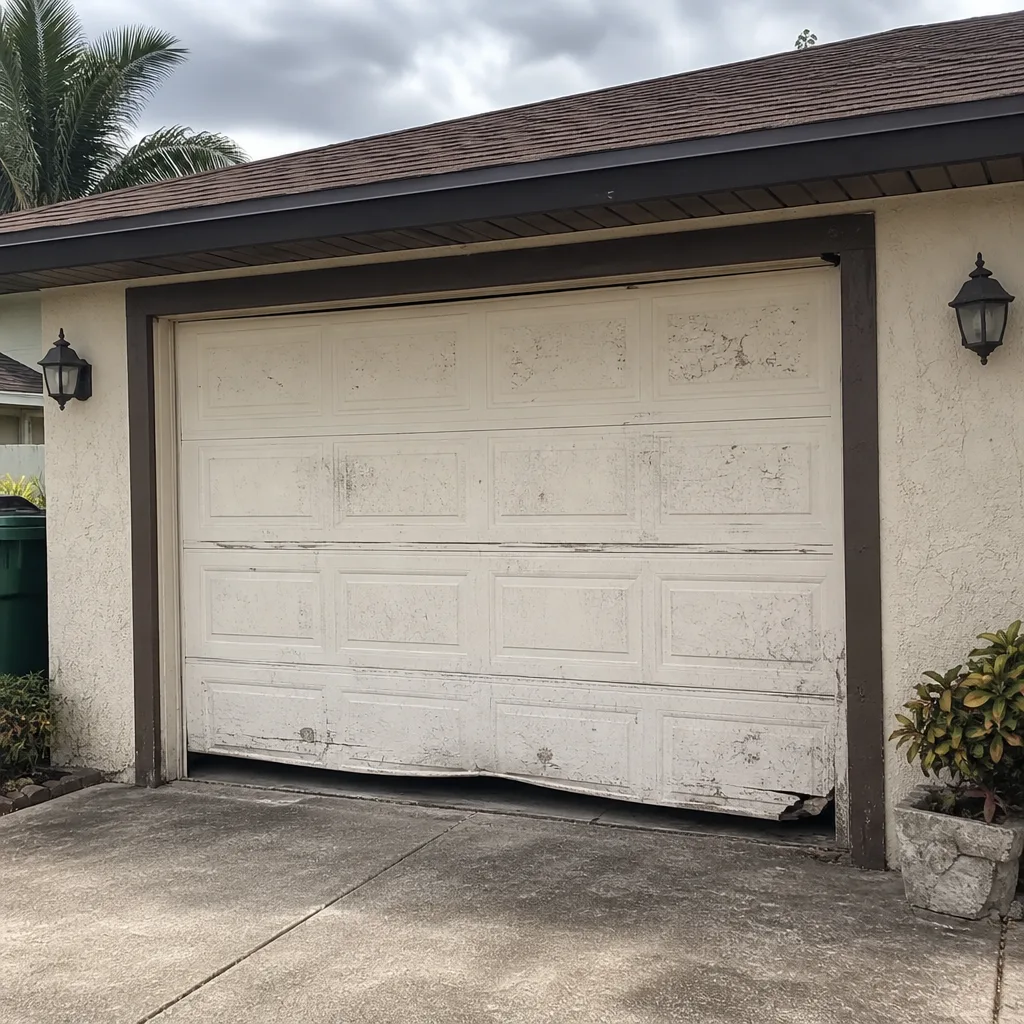 Before
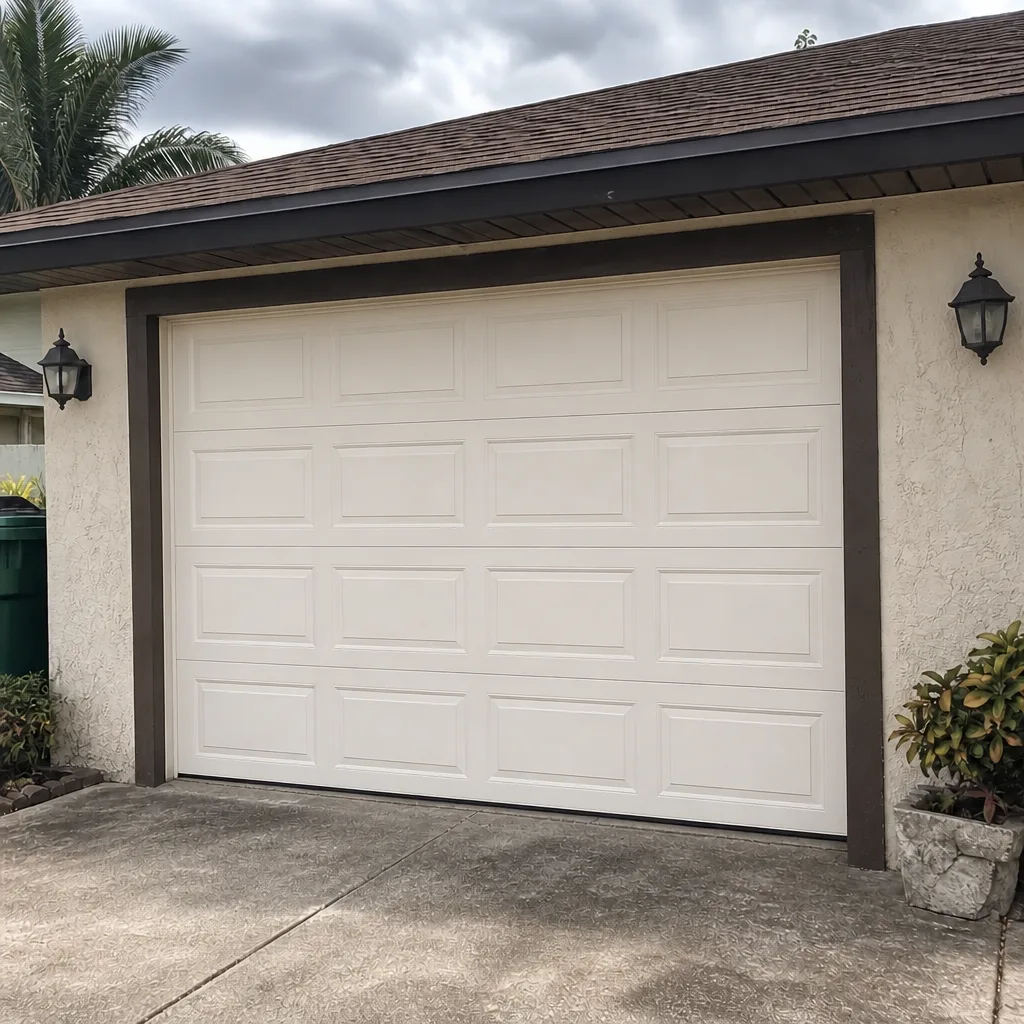 After
Common Mistakes to Avoid
- Buying the cheapest hardware. In this climate, plain steel springs and cables corrode fast. Paying a little more for coated or galvanized parts saves you a repeat repair.
- Replacing the opener when the door is the problem. If the springs are weak, a new opener just wears out on a heavy door. Fix the balance first.
- Ignoring a bottom seal on a slab floor. A gapped seal lets storm water and pests in, and it’s a small fix compared to water damage.
- Skipping the permit check on a new door. Lee County usually requires a permit for replacement. Confirm with your building department before work starts, and keep the door’s paperwork.
- Assuming a wind-load rating means it’s approved for your opening. The label rating has to match your address’s requirement, and the installation has to match the spec.
- Treating a spring as a weekend project. This is the most dangerous part of the system. Springs and cables under tension belong with a trained technician.
- Calling a general handyman for a brand-specific problem. A technician who knows your opener and door brand diagnoses the real cause instead of guessing and replacing parts until it works.
When to Call a Professional
Call a professional when you see a broken spring, a frayed cable, a door that won’t stay up, or a bracket pulling away from the door – those are safety issues, not projects. Call when your opener runs but the door won’t move, when the door reverses for no reason, or when you’ve replaced the remote batteries and it still won’t respond. Call before you buy a new door, so the wind-load requirement and permit are handled correctly from the start. And call if rust has started on the coils, because in Cape Coral humidity that’s a clock running down. Garage Door Repair Cape Coral Pros offers free estimates in Cape Coral – call (877) 492-3592. Our technicians have up to 12 years of experience, the local pro is licensed and insured as their state requires, and the price is quoted and agreed before any work starts.
Frequently Asked Questions
Spring repair in Cape Coral typically runs $180 to $340 for one spring, and since matched springs are usually replaced as a pair, a pair costs about twice that. The exact figure depends on the door’s size and the hardware grade you choose, and the written estimate sets the final price. Call (877) 492-3592 for an exact quote – estimates are free.
Spring failures are a repair we treat as urgent, and same-day service is often possible with fast dispatch from 7am to 7pm. Stop using the door once a spring has broken, because the remaining parts carry load they weren’t meant for. Call (877) 492-3592 and we’ll get you scheduled.
No – the price is quoted and agreed before any work starts, so what you’re told is what you pay. We look at the door, confirm what’s actually wrong, and give you a written estimate you approve first. If something changes the scope, you’ll hear it before any work happens, not on the invoice. Call (877) 492-3592 for an exact quote – estimates are free.
Most of Lee County requires a garage door that meets the wind-load standard for your specific address and opening, and the permit process will check it. A product’s wind-load rating has to match what your location requires, with the documentation and installation to back it up. Ask your city’s building department what applies to your address. For a free measure and a written price on a rated door, call (877) 492-3592.
We work on eight major door and opener brands: LiftMaster, Chamberlain, Genie, Clopay, Amarr, Wayne Dalton, Craftsman and Raynor. That covers the systems in most Cape Coral homes, from older Craftsman and Genie models to newer connected LiftMaster and Chamberlain units. If your door came with a brand name, we’ll diagnose it on its own terms rather than guess.
A yearly check is a sensible baseline here, because humidity speeds up wear on springs, cables and brackets. Some Cape Coral doors with heavy rust exposure benefit from a look more often. Between visits, lubricate the rollers and hinges and check the bottom seal yourself. Call (877) 492-3592 if you want a technician to check the balance and hardware.
The Bottom Line
The Cape Coral environment shapes every part of a garage door, from the grade of spring and cable you choose to the way your bottom seal sits on a slab floor. Get the hardware right for the humidity, match your door’s wind rating to your address and the permit, and keep an eye on the parts most exposed to moisture, and the door lasts like it should. The springs and cables are the safety-critical pieces – that’s the work to hand off. The full system, door, opener, springs and parts, is one call. For a free estimate, call (877) 492-3592.
Written by the team at Garage Door Repair Cape Coral Pros.